Hanging On By A Thread
*Two names have been changed for privacy concerns.
I wondered if the room felt cold because of the temperature, or because my fear was sending my blood to my limbs to prepare me to run. I was one week post-operative from my third experience with surgery needed to remove a tumor. Today the doctor will tell me the biopsy results. My fear of the “C” word was creeping back. Maybe third time is a charm? No, this news would be God’s will for my life, not luck.
“The tumor was large,” the surgeon explained. “I needed my assistant to hold it while I removed it. There were no abnormal cells in the tissue. You can expect six months for your body to adjust to the changes.”
Translation: No cancer. You will be tired for half a year.
Of course, I was thrilled to hear I was not dealing with cancer for the third time. I was already weak from the past four months of waiting for diagnosis, treatment, and surgery. Now I faced a six-month recovery. But Joni Camp was in three months.
An important volunteer job I do is with Joni and Friends (JAF) ministry to people with disabilities and their families. Each summer I spend a week at Joni and Friends Family Retreat, but we warmly call it Joni Camp. As a buddy to a person with a disability, volunteers allow family members to take a respite from their daily duties of care for them. Camp week is taxing both physically and mentally. Observing the daily struggles of our families will break your heart. I notified my state director to let her know I might not be strong enough to volunteer this year. We agreed to pray continually until two weeks before camp, then make our decision. I am part of my state JAF leadership on the prayer team, and I notified them of my need for guidance.
Each week I added longer walks to my exercise time. I kept eating well. Most of all, I said “no” to requests for my time so I could focus on recovery. Two weeks before camp, I let my director know I wanted to attend. I let my prayer partners know to change their prayer focus to physical strength for my week, as well as wisdom to relate to my camp buddy.
My buddy this year was a teenage girl I’ll call “Jessica”. Jessica had a diagnosis I had never heard of. In my brief research into the condition, I tried to understand what some of her limitations might be and how I could be of assistance and encouragement. Of course, Jessica would be my best instructor.
Jessica and I spent quiet times at a table working on jigsaw puzzles or small crafts. I was amazed at her attention to detail, her artistic eye for color and shapes. Historically, I would tell you I hate jigsaw puzzles because it takes too long and I don’t see the connections. Jessica taught me clues and tips about puzzles that changed my attitude for the better. I was very excited to watch her put down the last piece when we finished one.
We were a good match because we both needed extra rest in our day. Neither of us wanted to participate in physical activity so sitting quietly kept us both healthier. On our last day, Jessica gave me a brief hug as we said goodbye. We talked about meeting for a visit sometime. I was disappointed to learn that meeting would take place in a hospital within a month.
My concern for Jessica took the form of prayer most every day. The hospital she was in was two hours from my home. I felt pulled to visit her but feared I didn’t have the physical strength. Then, I needed to make a medical appointment four hours from home. My daughter and her husband lived in the city so I would have a place to stay and rest. But what about Jessica? Six hours of driving sounded impossible.
One day in prayer, I saw Jesus sitting on His throne in heaven rise and go stand behind Jessica’s hospital bed. He pointed at me to come too. In my mind I said I wasn’t strong enough to do both. He clearly reminded me His strength would be sufficient for my weakness.
I mapped my trip and sent Jessica’s mother “Donna” a text asking to see Jessica. She said I was welcome to visit and explained some of the hospital procedures regarding visitor security and room isolation. “I’ll meet you in the lobby. Text me when you are there,” she said.
The visitor badge was no small task. I provided my driver’s license for ID and had my photo taken. Both were used to create my badge which I clipped to my clothes. I waited a few minutes for Donna to come and take me to Jessica’s room on the sixth floor. As we rode the elevator, she explained some of the medical complications Jessica had endured. “You have come on a good day. We have some positive things today to be thankful for.” As we approached Jessica’s door, I read several signs warning staff to observe infection isolation techniques, as well as a caution that Jessica’s weakened physical state might make a fall more likely when she was out of bed. My young friend was dealing with a lot.
During camp, Jessica had taught me some quiet activities that could occupy my mind and time without taxing my system. I bought a small craft kit to make a picture I thought Jessica would like and planned to mail it to her. Instead, I gave it to her to decorate her hospital room.
We talked about Jessica’s favorite subject: her dogs. She was missing them terribly, but the video calls helped soothe her sadness. The doctors felt she was responding slowly but steadily to treatment. Although her attitude of calm acceptance and understanding of the treatment plan was a healthy choice, it put a lump in my throat to see her spending another long piece of her life in a hospital bed. My work with people with disabilities gives me a glimpse of the many facets of difficulty the person and their families deal with every day. I can’t handle it for 20 minutes.
Although Jessica’s body was slowly recovering, I felt it best to keep my visit short, for her sake and mine. I needed to get on the road for the rest of my journey. I was fighting my fear that I was still too weak to accomplish it all. When I returned to the parking garage, I sat in my car and opened my maps app to check on the route ahead of me. Under “Next stop” the time stamp said 2 hours, 35 minutes. What? How? I expected four and a half hours.
I made a mistake when mapping my drive. I had only two and a half hours for the next leg of my journey. I felt great relief, and a big load lifted from my shoulders. I was no longer afraid. I was confident I had the energy to make the shorter drive.
“Dear Father, thank you for helping me get this far today. Thank you that my next drive is so much less than I feared. I am sorry for my fear. Thank you for your mercy in helping me have strength to drive. Amen.”
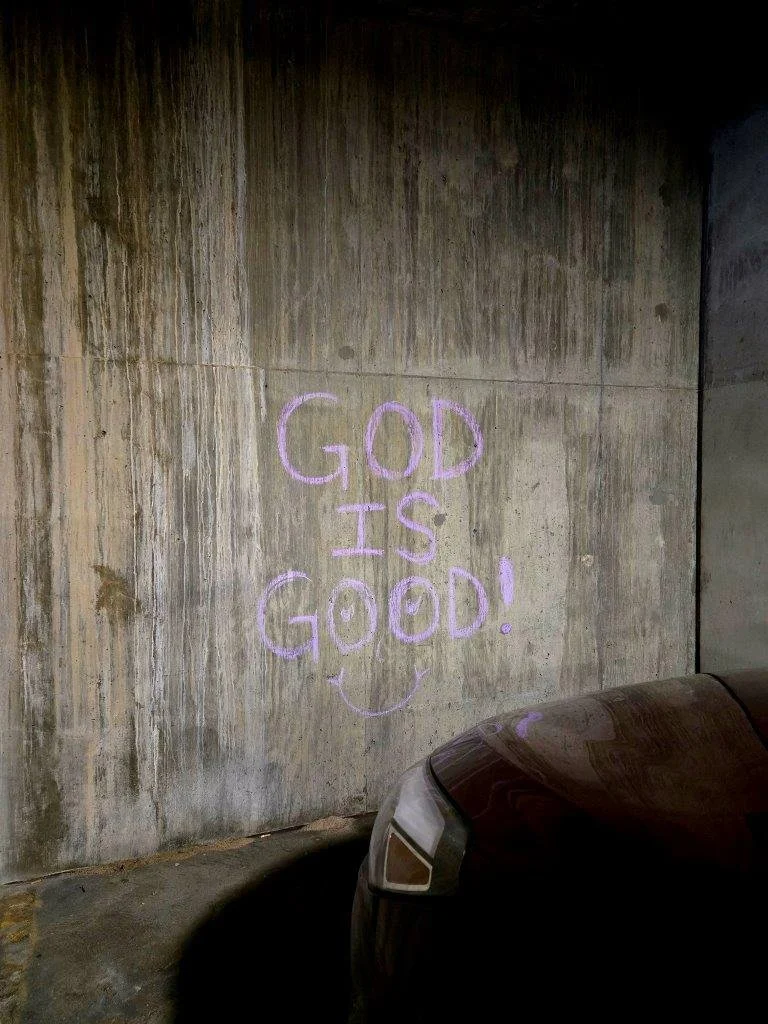
I turned my ignition key and the car headlights shone on the concrete garage wall in front of my car. I sucked in a breath in amazement at what I saw.
There on the concrete wall in front of my car, printed in purple chalk, were the words, “God is Good” and a smiley face.
As tears filled my eyes, I prayed aloud, “Yes, God, you are certainly good. Thank you for helping me get to Jessica. Thank you I do not feel exhausted or shaky. Thank you I have only two and a half hours to drive to Mandy’s, not another four.”
In this Bible passage in a modern translation called The Message, Paul wrote to Christians in the church in Corinth regarding his belief of how to manage a physical handicap, as well as the struggles he experienced in his life. “Because of the extravagance of those revelations, [from a heavenly vision he had] and so I wouldn’t get a big head, I was given the gift of a handicap to keep me in constant touch with my limitations. Satan’s angel did his best to get me down; what he in fact did was push me to my knees. No danger then of walking around high and mighty! At first I didn’t think of it as a gift, and begged God to remove it. Three times I did that, and then he told me, My grace is enough; it’s all you need. My strength comes into its own in your weakness. Once I heard that, I was glad to let it happen. I quit focusing on the handicap and began appreciating the gift. It was a case of Christ’s strength moving in on my weakness. Now I take limitations in stride, and with good cheer, these limitations that cut me down to size—abuse, accidents, opposition, bad breaks. I just let Christ take over! And so the weaker I get, the stronger I become. “
II Corinthians 12:7-10 The Message
I am no Apostle Paul, and I do not pretend to be without fault. But like Paul, I recognize that my human frailties can make me bitter or better. I can stay angry at the things I cannot do or what I do not understand, or I can be thankful for the things I can do. As I age, my list of things to do gets harder and shorter. Yet, in my weakness, I will be strong, for the LORD is my strength and my salvation. In Him will I trust. And that thin thread I feel becomes thick as a tow rope!